

Ushanka vs börk vs kalpak vs papak is not just a style comparison. These traditional winter hats differ in shape, ear coverage, cultural background, materials and the way they sit on the head.
If you are deciding which style suits you best, this guide gives you a practical comparison first, then explains each hat in more detail. For sizing, use our Leather Hat Sizing Guide. For a broader purchase checklist, see our Leather Hat Buying Guide.
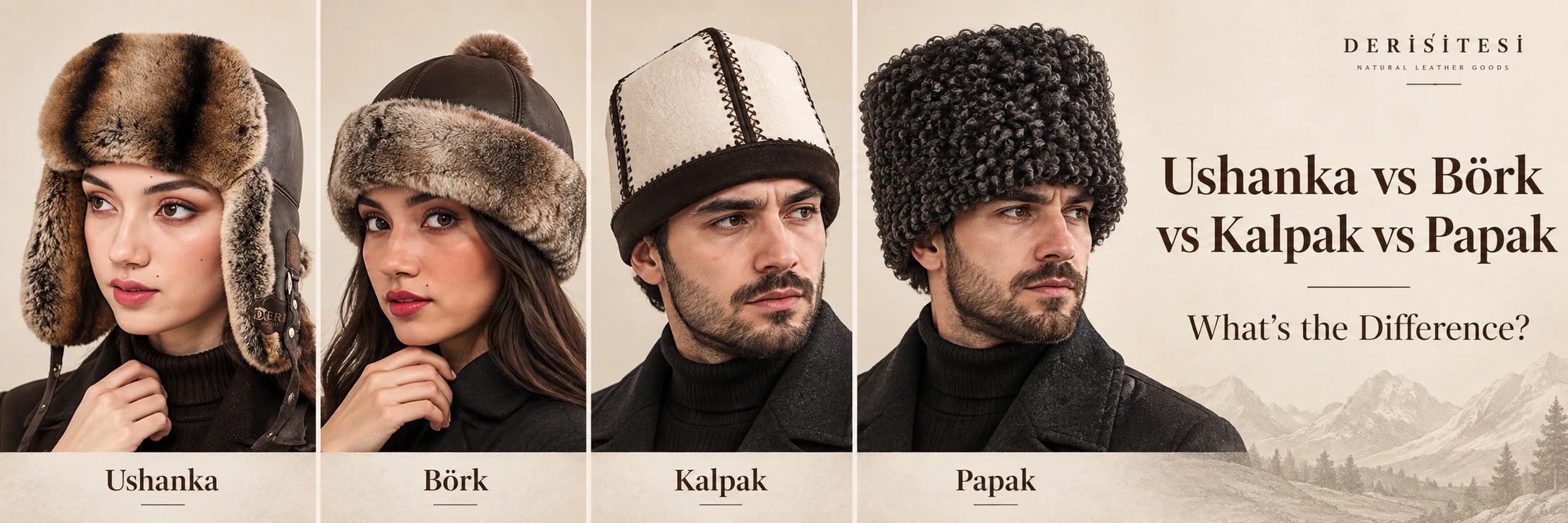
Ushanka vs Börk vs Kalpak vs Papak: Quick Comparison
Ushanka
Best for: cold and windy weather
Key feature: fold-down ear flaps
Typical look: practical, winter-focused, pilot/trapper style
Börk
Best for: traditional Turkic style and everyday winter wear
Key feature: close or rounded crown, often leather and sheepskin
Typical look: compact, heritage-inspired, versatile
Kalpak
Best for: a more structured traditional silhouette
Key feature: taller or more defined crown
Typical look: formal, historic, statement-oriented
Papak / Papakha
Best for: Caucasian-inspired traditional style
Key feature: dense fur and cylindrical volume
Typical look: bold, high-volume, ceremonial or cultural
What Is an Ushanka?
An ushanka is a winter hat defined by its ear flaps. The flaps can usually be worn down for extra protection or tied/folded upward when less coverage is needed. This functional design makes ushanka-style hats especially useful in cold, windy weather.
Materials vary by model. Leather versions may use genuine lambskin or sheepskin on the outside, while the inside may be lined with sheepskin, textile or another insulating material. Because the ear flaps add coverage around the sides of the head, an ushanka can feel more protective than a hat with no ear coverage.
Browse current Leather Ushanka Hats.
What Is a Börk?
A börk is associated with older Turkic headwear traditions and today appears in many leather and sheepskin interpretations. Compared with an ushanka, it usually has a cleaner, more compact profile and does not depend on large fold-down ear flaps for its identity.
Some börk models are simple and rounded, while others include fur, sheepskin or decorative elements. This makes börk a flexible option for buyers who want a traditional look without the full trapper-style appearance of an ushanka.
Browse Turkish Börk Hats.
What Is a Kalpak?
A kalpak generally has a taller and more structured silhouette than a low-profile börk. Depending on the design, it may look cylindrical, slightly tapered or more vertical through the crown.
Because of its shape, a kalpak can create a stronger visual presence. It is often chosen by buyers who want a traditional hat with a more formal or historic appearance rather than a casual winter cap.
Browse Leather Kalpaks.
What Is a Papak or Papakha?
Papak, also written as papakha or papaq in different contexts, is associated with traditional Caucasian headwear. The most recognizable versions use dense fur and have a fuller, cylindrical silhouette.
Compared with a börk or a typical kalpak, a papak usually creates more volume around the head. It is often selected for cultural dress, traditional styling or a bold winter look.
Main Difference #1: Ear Coverage
The biggest practical distinction is ear protection:
- Ushanka: usually offers the most obvious ear coverage because the ear flaps can be lowered.
- Börk: usually has a cleaner profile; ear coverage depends on the individual design.
- Kalpak: generally does not use large fold-down ear flaps.
- Papak: is typically identified by its fur volume rather than separate ear flaps.
If wind protection around the ears is your priority, an ushanka-style hat is the most straightforward starting point.
Main Difference #2: Shape and Silhouette
Shape changes how the hat looks on the wearer:
- Ushanka: wider and more functional, especially with the flaps down.
- Börk: compact and rounded or close-fitting.
- Kalpak: taller and more structured.
- Papak: dense, full and cylindrical.
If you prefer a lower-profile everyday look, start with a börk. If you want a stronger vertical silhouette, compare kalpak styles. For a fuller traditional look, papak is the most visually substantial of the four.
Main Difference #3: Materials
There is no single material rule for every model. Depending on the specific product, these hats may use genuine lambskin leather, sheepskin, wool, textile lining, faux fur or other trims.
For that reason, avoid choosing a hat based only on the category name. Check the actual product description for:
- outer material
- lining material
- fur or faux-fur details
- stitching and construction
- care instructions
Main Difference #4: Warmth
Warmth depends more on construction than on the name of the hat. A lightly lined leather kalpak may feel very different from a thick sheepskin kalpak, just as one ushanka may be much warmer than another.
For cold-weather use, check the thickness of the lining, whether the ears are covered, how snugly the hat fits, and whether the materials are intended for winter use.
Which Hat Is Best for Everyday Wear?
For everyday city use, a börk is often the easiest traditional style to integrate into a normal winter wardrobe because it can be compact and relatively understated.
An ushanka is better when practical cold protection matters more than a streamlined appearance. A kalpak works well when you want a more structured statement. A papak is the most visually distinctive and usually suits buyers specifically looking for a fuller traditional style.
Which Hat Is Best for Very Cold Weather?
If you need additional ear coverage, start by comparing ushanka-style hats. For any style, however, material and lining matter more than the category name alone.
A thick sheepskin-lined börk or kalpak can also perform well in cold conditions. Always check the exact product construction instead of assuming every ushanka is warmer than every börk or kalpak.
Which Style Works Best with Your Face and Head Shape?
Hat proportions can visually change the balance of the face:
- A taller kalpak can add vertical emphasis.
- A compact börk can create a closer, more balanced silhouette.
- An ushanka adds width around the sides when the flaps are down.
- A full papak creates the strongest volume around the upper head.
Fit still matters more than visual theory. Measure your head first and use the correct size rather than choosing a smaller or larger hat only to change the silhouette.
Sizing: Do These Hats Fit Differently?
Yes. Even when two hats use the same nominal size, the internal feel can differ because of lining thickness, crown construction and fur/sheepskin volume.
DeriSitesi standard adult sizing generally runs from XS (53–54 cm) to 3XL (65–66 cm) on suitable models. For cm, inches and US numeric conversions, use the Leather Hat Sizing Guide.
Ushanka vs Börk vs Kalpak vs Papak: Which One Should You Buy?
Use this quick rule:
- Choose an ushanka if ear protection and winter practicality come first.
- Choose a börk if you want a compact traditional Turkic-inspired look.
- Choose a kalpak if you prefer a taller, more structured traditional silhouette.
- Choose a papak if you want a fuller Caucasian-inspired fur hat with strong visual presence.
Before buying, compare the actual material, lining and sizing of the specific model. Our broader Leather Hat Buying Guide covers these purchase factors in more detail.
Explore Traditional Winter Hat Styles
Compare handmade börk, kalpak and related traditional winter hats in the current DeriSitesi collection.
FAQ
Is a börk the same as a kalpak?
No. The terms can overlap in casual usage, but the styles generally differ in shape and historical context. Börk models are often more compact, while kalpaks are commonly taller or more structured.
Is an ushanka always made with fur?
No. Materials vary by product. Some models use sheepskin or fur, while others use leather with textile, synthetic or faux-fur linings and trims.
Which is warmer: ushanka or kalpak?
There is no universal answer. Warmth depends on lining thickness, ear coverage, materials, fit and weather conditions. Compare the construction of the specific products.
What is the difference between papak and kalpak?
A papak is generally fuller and fur-dominant with a cylindrical Caucasian-style silhouette, while a kalpak is often more structured and can use leather, sheepskin or other materials in a taller crown shape.
Where can I buy handmade traditional leather hats?
You can explore current models through the DeriSitesi international storefront, including börk hats, kalpaks and ushanka hats.
[…] For more detail, see our guide to Ushanka vs Börk vs Kalpak vs Papak. […]
[…] If you want a broader comparison of traditional winter styles, see our Ushanka vs Börk vs Kalpak vs Papak guide. […]