
Leather hat sizing starts with one simple measurement: your head circumference. A leather hat can look perfect in photos and still feel uncomfortable if the size is wrong. Too tight, and it can create pressure around the forehead and temples; too loose, and it may shift, sit too low, or move in windy weather.
This guide explains how to measure your head correctly, how DeriSitesi hat sizes correspond to centimeters, what to do if you are between sizes, and how fit can change between leather caps, börks, kalpaks, ushankas and other winter hats.
Table of Contents
- DeriSitesi Leather Hat Size Chart
- What If You Are Between Two Sizes?
- Snug Fit vs Relaxed Fit
- Large Leather Hat Sizes: 61–66 cm
- Do Leather Hats Stretch Over Time?
- How Fit Changes by Hat Style
- How Should a Properly Fitted Leather Hat Feel?
- Common Leather Hat Sizing Mistakes
- Buying a Leather Hat as a Gift
- Leather Hat Sizing FAQ
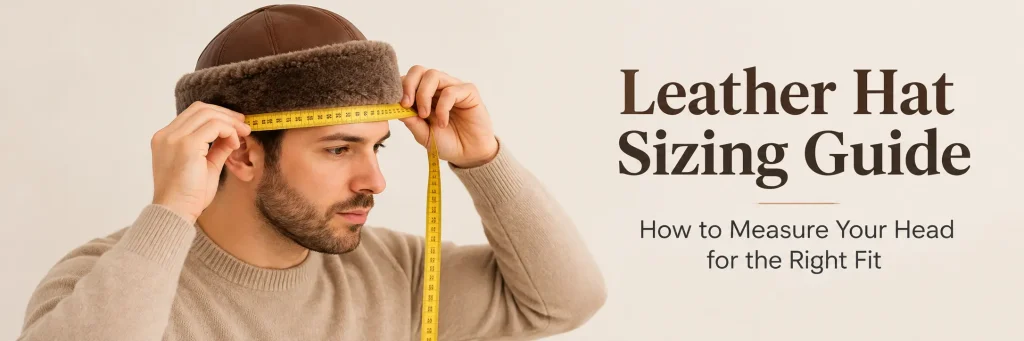
Use a soft tailor’s measuring tape if possible. If you do not have one, use a piece of string and measure the string with a ruler afterward.
- Place the tape about 1 cm above your eyebrows. This is close to where the lower edge of most hats will sit.
- Run the tape above your ears. Keep it roughly horizontal around the head.
- Wrap it around the widest part of the back of your head.
- Keep the tape snug, not tight. Do not pull it hard enough to compress the skin.
- Read the measurement in centimeters. Measure twice to make sure you get the same result.
If the two measurements are different, repeat the process once more. For hat sizing, a consistent measurement is more useful than trying to estimate from a hat you already own.
DeriSitesi Leather Hat Size Chart
Our standard adult hat sizing is based on head circumference. The chart below also includes approximate inch measurements plus traditional US and UK numeric hat sizes for international customers. 1 inch = 2.54 cm. Numeric hat sizes can vary slightly by brand and hat shape, so your exact head circumference remains the most reliable reference.
| DeriSitesi Size | Head Circumference (cm) | Head Circumference (inches) | Approx. US Hat Size | Approx. UK Hat Size |
|---|---|---|---|---|
| XS | 53–54 cm | 20.9–21.3 in | 6 5/8–6 3/4 | 6 1/2–6 5/8 |
| S | 55–56 cm | 21.7–22.0 in | 6 7/8–7 | 6 3/4–6 7/8 |
| M | 57–58 cm | 22.4–22.8 in | 7 1/8–7 1/4 | 7–7 1/8 |
| L | 59–60 cm | 23.2–23.6 in | 7 3/8–7 1/2 | 7 1/4–7 3/8 |
| XL | 61–62 cm | 24.0–24.4 in | 7 5/8–7 3/4 | 7 1/2–7 5/8 |
| 2XL | 63–64 cm | 24.8–25.2 in | 7 7/8–8 | 7 3/4–7 7/8 |
| 3XL | 65–66 cm | 25.6–26.0 in | approx. 8 1/8–8 1/4 | approx. 8–8 1/8 |
US and UK numeric hat sizes are approximate. Different brands and crown shapes can fit differently, so measure your actual head circumference whenever possible. Once you know your size, our Leather Hat Buying Guide can help you compare styles, materials and fit.
Example: if your head circumference is 58 cm, the usual starting point is Medium. If it is 60 cm, Large is the usual choice.
DERISITESI SHOP · LEATHER HATS
Know your size? Find a leather hat that fits.
Use your head measurement to compare handmade leather hats. Check the size and lining details of each style before choosing.
What If You Are Between Two Sizes?
If your measurement falls exactly between two size ranges, do not automatically choose the larger size. First check the specific product description because lining thickness, fur trim, crown shape and construction can affect how a hat feels.
As a general rule, a hat should sit securely without creating painful pressure. A slightly snug leather hat may relax a little with wear, but a clearly undersized hat should not be purchased with the expectation that it will stretch by a full size.
If you are unsure, send us your exact head circumference and the model you are considering before ordering. This is especially useful for thick sheepskin-lined winter hats and traditional styles with less flexible construction.
Snug Fit vs Relaxed Fit: Which Should You Choose?
A snug fit means the hat stays securely in place and follows the head closely without creating pain, numbness or a strong pressure line. This can work well for leather caps and winter hats that need to remain stable in wind.
A relaxed fit allows a little more room inside the crown. It can feel more comfortable for long wear, thicker hair or structured traditional styles, but it should not be so loose that the hat drops toward the eyes or moves when you turn your head.
Do not create a relaxed fit simply by choosing a full size larger. Start with your measured circumference, then consider the specific model, lining thickness and how you prefer the hat to sit.
Large Leather Hat Sizes: 61–66 cm
If your head circumference is 61–62 cm, the usual DeriSitesi starting point is XL. For 63–64 cm, start with 2XL, and for 65–66 cm, suitable models may be available in 3XL.
Large-size buyers should pay particular attention to the inside construction. Thick sheepskin, padded lining or a rigid crown can make two hats with the same labeled circumference feel different. Check the individual product description and, when in doubt, send us your exact head measurement and the model name before ordering.
A larger label should not be used as a substitute for measuring. A 62 cm head, for example, should normally begin with the 61–62 cm range rather than automatically moving to 2XL unless the specific model is described as fitting small.
Do Leather Hats Stretch Over Time?
Genuine leather can soften and adapt slightly to the wearer with use, warmth and movement. That does not mean a leather hat should feel painfully tight when new.
A correct fit should feel secure around the head without strong pressure points. Over time, the leather may become more comfortable and conform more naturally to your head shape, but the amount of stretch depends on the leather, lining and construction of the specific model.
How Fit Changes by Hat Style
Leather Caps and Everyday Leather Hats
These usually follow the size chart closely. The hat should sit firmly enough not to shift when you move your head, but it should not leave a strong pressure line on the forehead.
Börk Hats
A börk usually sits close to the head. Fur or thick lining can reduce the usable inner volume, so the same nominal size may feel more fitted than a thin leather cap.
Kalpak Hats
A kalpak has a more structured silhouette. It should sit securely without being tight enough to distort the shape of the hat.
Ushanka and Pilot-Style Winter Hats
For ushanka-style hats, the fit should remain comfortable whether the ear flaps are worn up or down. Thick lining can make these models feel more fitted, so always check the individual product notes. For more detail on ushanka fit and ear-flap construction, see our dedicated guide.
How Should a Properly Fitted Leather Hat Feel?
- It should stay in place when you turn or tilt your head.
- It should not slide down over your eyes.
- It should not create pain or strong pressure around the forehead.
- You should be able to wear it for an extended period without discomfort.
- The crown and brim should keep their intended shape.
Common Leather Hat Sizing Mistakes
Measuring Too High on the Head
If you measure above the point where the hat will actually sit, the result can be too small. Keep the tape close to the natural hat line above the eyebrows and ears.
Pulling the Tape Too Tight
A tight tape gives an artificially small measurement. The tape should touch the head all the way around without compressing it.
Guessing Based on Height, Weight or Gender
Head circumference cannot be predicted reliably from body size. Two people of similar height can have very different hat sizes. Measure the actual head circumference whenever possible.
Assuming Every Hat Fits the Same
Leather thickness, sheepskin lining, fur trim and crown construction can change the feel of a hat. Use the size chart as the starting point, then read the model-specific sizing notes.
Buying a Leather Hat as a Gift
The safest option is to find the recipient’s actual head circumference. If that is not possible, check the size label inside a hat they already wear comfortably. Avoid relying only on age, height or general adult averages.
For custom or special-size production, availability and return/exchange conditions can differ from standard-stock items. Confirm the current terms before ordering a personalized size.
Leather Hat Sizing FAQ
What hat size is 58 cm?
In the DeriSitesi chart, 58 cm falls within Medium (57–58 cm).
What hat size is 60 cm?
60 cm falls within Large (59–60 cm).
What size should I choose for 61–62 cm?
61–62 cm corresponds to XL in our standard chart.
How do I convert inches to centimeters for hat sizing?
Multiply the measurement in inches by 2.54. For example, 24 inches × 2.54 = 60.96 cm, which is approximately 61 cm.
What leather hat size is 24 inches?
A 24-inch head circumference is about 61 cm. In the DeriSitesi chart, 61–62 cm corresponds to XL.
What does US hat size 7 1/4 equal in centimeters?
A traditional US hat size of 7 1/4 is approximately 58 cm, which falls within Medium (57–58 cm) in the DeriSitesi chart.
Do you make large leather hat sizes?
Yes. Our standard chart extends through 3XL for 65–66 cm on suitable models. Availability depends on the specific product.
Should a leather hat feel tight at first?
It may feel slightly snug, especially with genuine leather or thick lining, but it should not cause pain or strong pressure. Do not buy a clearly undersized hat expecting it to stretch dramatically.
Can I ask for help before ordering?
Yes. Send us your head circumference in centimeters and the hat model you are considering. We can help you compare the measurement with the sizing information for that model.
What DeriSitesi customers mention
Public Etsy reviews often mention fit, craftsmanship, material quality and international delivery. For sizing, the most reliable starting point is still your actual head circumference rather than a familiar size label.
Ready to Choose Your Leather Hat?
Now that you know your head size, compare handmade men’s leather hats by shape, lining, material and winter coverage.
For wholesale orders, you can also read our Wholesale Leather Hats & Börks guide.
[…] For a full centimeter, inch and US numeric conversion chart, read our Leather Hat Sizing Guide. […]
[…] gives you a practical comparison first, then explains each hat in more detail. For sizing, use our Leather Hat Sizing Guide. For a broader purchase checklist, see our Leather Hat Buying […]
[…] full Leather Hat Sizing Guide explains the measurement process in more […]
[…] This workshop guide explains the production process from the first material check to the final inspection. If you are comparing finished hats rather than production methods, start with our Leather Hat Buying Guide. For head measurement and fit, see the Leather Hat Sizing Guide. […]
[…] Special Production Options: Selected logo, label, color, sizing, or design requests can be evaluated according to model, quantity, and production feasibility. For how our hats are constructed, see How a Leather Hat Is Made; for measurement guidance, use the Leather Hat Sizing Guide. […]
[…] circumference. If you do not, ask someone close to him to help measure it rather than guessing. Our Leather Hat Sizing Guide explains the process. You can compare actual shapes in the men’s leather hats […]
[…] Use this as a starting point, then check the individual model because thick sheepskin or padded lining can change the internal feel. For the full measuring method and international conversions, use our Leather Hat Sizing Guide. […]
[…] For the complete cm/inch conversion table and measurement method, see our Leather Hat Sizing Guide. […]
[…] This guide explains the practical difference between sheepskin and shearling hats, how those materials affect warmth and fit, and what to check before ordering. For general hat construction and buying advice, see our Leather Hat Buying Guide. If sizing is your main concern, use the Leather Hat Sizing Guide. […]